

Food intolerances and food allergies affect many people worldwide. They can significantly impair quality of life and pose a challenge that not only restricts food choices but can also negatively impact overall well-being. Understanding and effectively managing these conditions requires a fundamental knowledge of the differences between them, their typical triggers and symptoms, and the available diagnostic and treatment methods. A healthy gut plays a central role in allergy protection, as it helps regulate the immune system and prevent overreactions to harmless food components. An intact intestinal barrier and a balanced gut microbiome promote food tolerance and can thus reduce the risk of food allergies. Conversely, a disrupted microbiome can mislead the immune system and promote the development of allergies.
Benötigen Sie eine persönliche Beratung?
Unsere medizinisch-wissenschaftliche Abteilung steht Ihnen für fachliche Fragen gerne zur Verfügung. Sie erhalten eine individuelle, kostenfreie Beratung durch unser geschultes Fachpersonal – per E-Mail, über die Chat-Funktion auf unserer Website oder telefonisch über unsere Hotline.


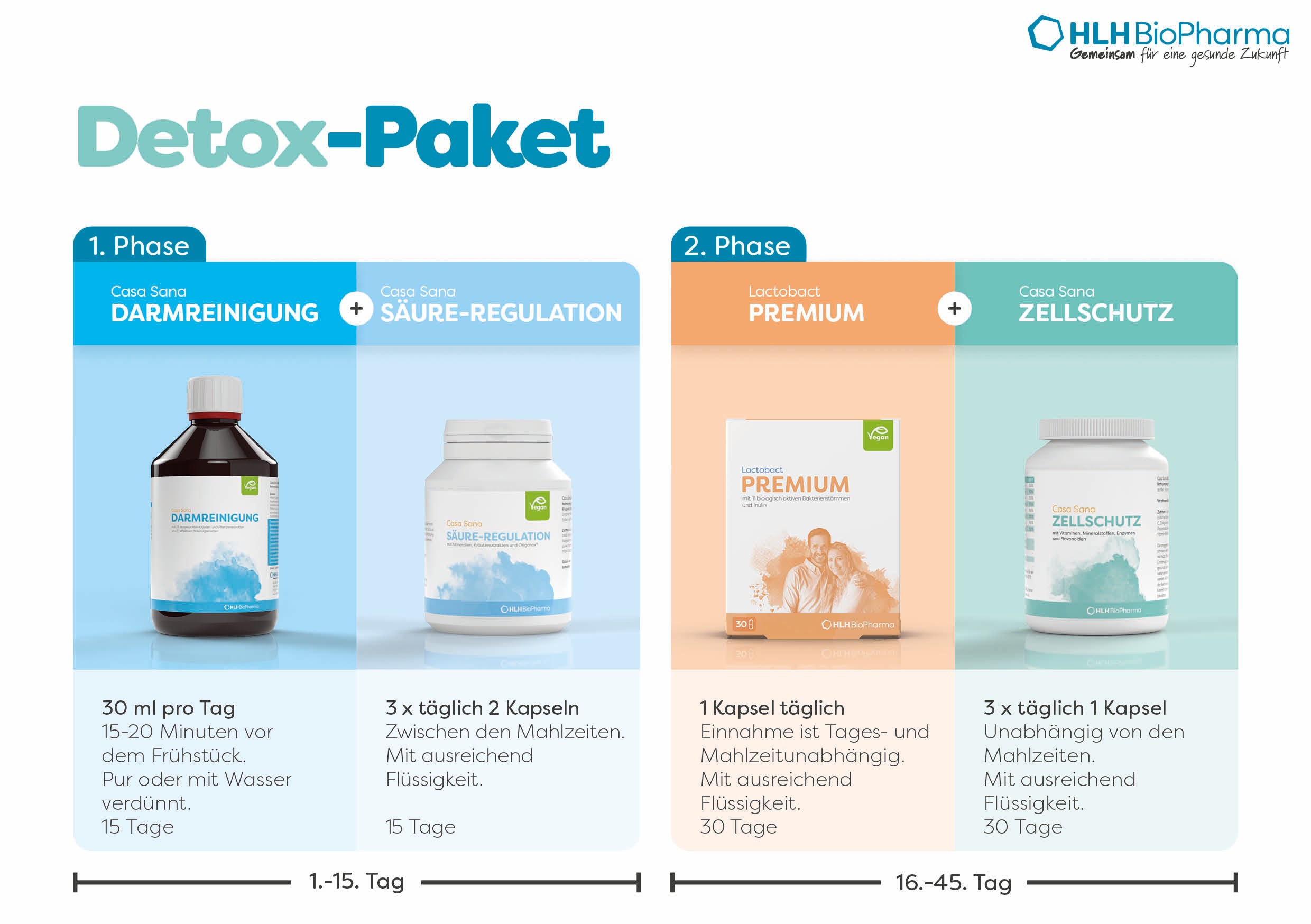
Sale
Detox Package
Detox Package
Sale price
EUR 99,49 €
Regular price
EUR 110,55 €
Unit price
EUR 164,12 €/kg
The Difference Between Food Intolerances and Food Allergies
While a food allergy represents a reaction of the immune system that can potentially be life-threatening, food intolerances are usually less serious and primarily affect the digestive system. However, regardless of whether it is an intolerance or an allergy, the result is often the same: discomfort and the need to avoid certain foods. Typical symptoms of allergies can include rashes, itching, or even anaphylaxis. A food intolerance, often also called a food sensitivity, typically affects the digestive system and manifests as symptoms such as diarrhea, bloating, or abdominal pain.
The Most Common Triggers of Food Intolerances
The most well-known forms of food intolerance include lactose intolerance and gluten intolerance (celiac disease). Lactose intolerance is the inability to digest lactose, a sugar found in dairy products. Celiac disease, on the other hand, is a serious intolerance to gluten, a protein found in wheat, barley, and rye. Another form is histamine intolerance, in which the body has difficulty breaking down histamine, which is found in certain foods such as aged cheese and wine. The gut plays a central role in the development of intolerances and allergies, as it is crucial for nutrient absorption and immune defense.
Diagnosis and Management
The diagnosis of a food intolerance or allergy often begins with a detailed symptom diary and can be confirmed through elimination diets and specific tests, such as blood tests or skin tests,. It is important to identify the triggering foods in order to remove or replace them in the diet. Typically, a broad differential diagnosis of different organ systems is carried out. Therapy includes dietary adjustments to determine individually tolerable amounts of “problematic” foods.
Food Intolerances: Facts, Symptoms, and Solutions
Food intolerances are among the most common complaints worldwide and are associated with numerous restrictions for those affected. Celiac disease and wheat allergy can now be definitively diagnosed by a specialist. In gluten or wheat sensitivity, similar symptoms to celiac disease or wheat allergy are present. It is unclear if there are other triggers in wheat. The diagnosis of gluten or wheat sensitivity, however, is made only by excluding celiac disease and wheat allergy and performing a gluten-free elimination diet followed by a controlled challenge test.
If you suffer from celiac disease, wheat allergy, or gluten/wheat sensitivity, avoiding the food with disease-triggering ingredients is the only sensible therapy. This causes the symptoms to subside or disappear.
The range of “free-from” products, such as gluten-free products, has increased significantly in recent years. The introduction of allergen labeling represents a clear improvement in health protection for those affected and makes food selection easier.
Celiac Disease
People diagnosed with celiac disease must eat gluten-free for life and therefore rely on the availability of gluten-free foods. In most gluten-free products, the specific binding properties are replaced by starches from other cereals combined with thickeners and hydrocolloids. The following alternatives have proven effective:
- Rice and corn starch: They also possess gelling properties.
- Branched-chain amylopectin.
Both have gelling properties and can replace the missing gluten. Avoiding gluten and using other ingredients or foods leads to changes in energy and nutrient intake, which affected individuals must pay special attention to. Pseudocereals such as quinoa, amaranth, or buckwheat have proven effective, as they are naturally gluten-free but rich in high-quality proteins, carbohydrates, and minerals.
Lactose Intolerance
Lactose intolerance (often also called lactose malabsorption) is one of the most common intolerances and leads to digestive complaints such as abdominal pain, bloating, gas, or nausea. Very few people with lactose intolerance must completely avoid lactose. They often tolerate small amounts found in a slice of cheese, yogurt, or processed foods.
Fructose Intolerance
Fructose intolerance, also known as fructose malabsorption, is a digestive disorder in which the body has difficulty processing fructose effectively. This intolerance can cause various digestive complaints, such as bloating, abdominal pain, diarrhea, or constipation, when consuming fructose-containing foods. The intolerance results from the small intestine’s reduced ability to absorb fructose, causing undigested fructose to reach the large intestine, where it leads to digestive problems. An adapted diet that reduces fructose intake is often key to alleviating symptoms.
Forms of Food Allergies
Four to six percent of all children and one to three percent of adults in Germany suffer from a food allergy, and the trend is increasing. Colloquially, people often speak of food allergies and food intolerances – but what exactly is the difference? Food allergies, now called food hypersensitivities, are defined as the ingestion of food accompanied by an immune reaction. The symptoms of those affected are diverse. Triggers of the allergic reaction are proteins or protein-bound substances. These are unknown to the body and therefore trigger an immune response. Two forms of food hypersensitivity are distinguished: IgE-mediated and non-IgE-mediated forms.
The IgE-mediated form, also called the immediate-type reaction, leads to symptoms within seconds to a few minutes. A secondary reaction may occur after four to six hours. The non-IgE-mediated form only causes symptoms after 12 to 72 hours and is therefore called a delayed-type reaction. Symptoms are individual and varied, including vomiting, diarrhea, itching, or shortness of breath. In case of symptoms, medical diagnostics and a therapeutic elimination diet should follow.
Strategies for Coping
Both food intolerances and food allergies are complex conditions that can significantly affect those affected. Through understanding, knowledge of symptoms, and correct diagnosis, effective strategies for coping can be developed. Professional advice and tailored nutrition can help alleviate symptoms and improve quality of life. It is important to listen to your body’s signals and seek medical advice if you suspect a food intolerance or allergy. For both forms, the following measures are recommended:
- Elimination diet: Remove the suspected food from your diet for a certain period and observe whether symptoms improve.
- Substitute products: Today, there are numerous substitute products for common allergens such as lactose or gluten.
- Professional advice: Nutritional counseling can provide individually tailored solutions.
It is essential that affected individuals learn to read food labels to avoid potential allergens or ingredients that trigger intolerances. Additionally, a balanced diet adapted to individual needs can help strengthen the immune system and promote gut health.
Regaining Quality of Life Despite Food Intolerances or Allergies
Living with food intolerances can be a significant challenge, especially for people with chronic inflammatory bowel diseases (IBD). Proper nutrition plays a crucial role in managing these conditions and improving quality of life.
At HLH BioPharma, we offer a range of products specifically designed to support people with IBD and food intolerances and allergies. Discover Casa Sana Gut Cleanse, Casa Sana Cell Protection, Casa Sana MAXIAMIN, and other premium probiotics from HLH BioPharma for your gut health!
_____________________________________________________
Sources:
- Schäfer, A. Constien, Dr. I. Reese, 2007: Praxisbuch Lebensmittelallergie: The Sure Path to Correct Diagnosis and Optimal Therapy for Allergies and Intolerances; online at: Google Books
- Klammer, 2013: Food Intolerances: General Principles, Diagnostics, and Therapy; online at: https://unipub.uni-graz.at/obvugrhs/233854
- Gotua, N. Lomidze, N. Dolidze, 2008: IgE-Mediated Food Hypersensitivities; online at: https://pubmed.ncbi.nlm.nih.gov/18487689/
- Smollich, A. Vogelreuter, 2nd edition, 2018: Food Intolerances
DGE, 2018: Intolerances: When are “Free-From” Foods Useful?


